
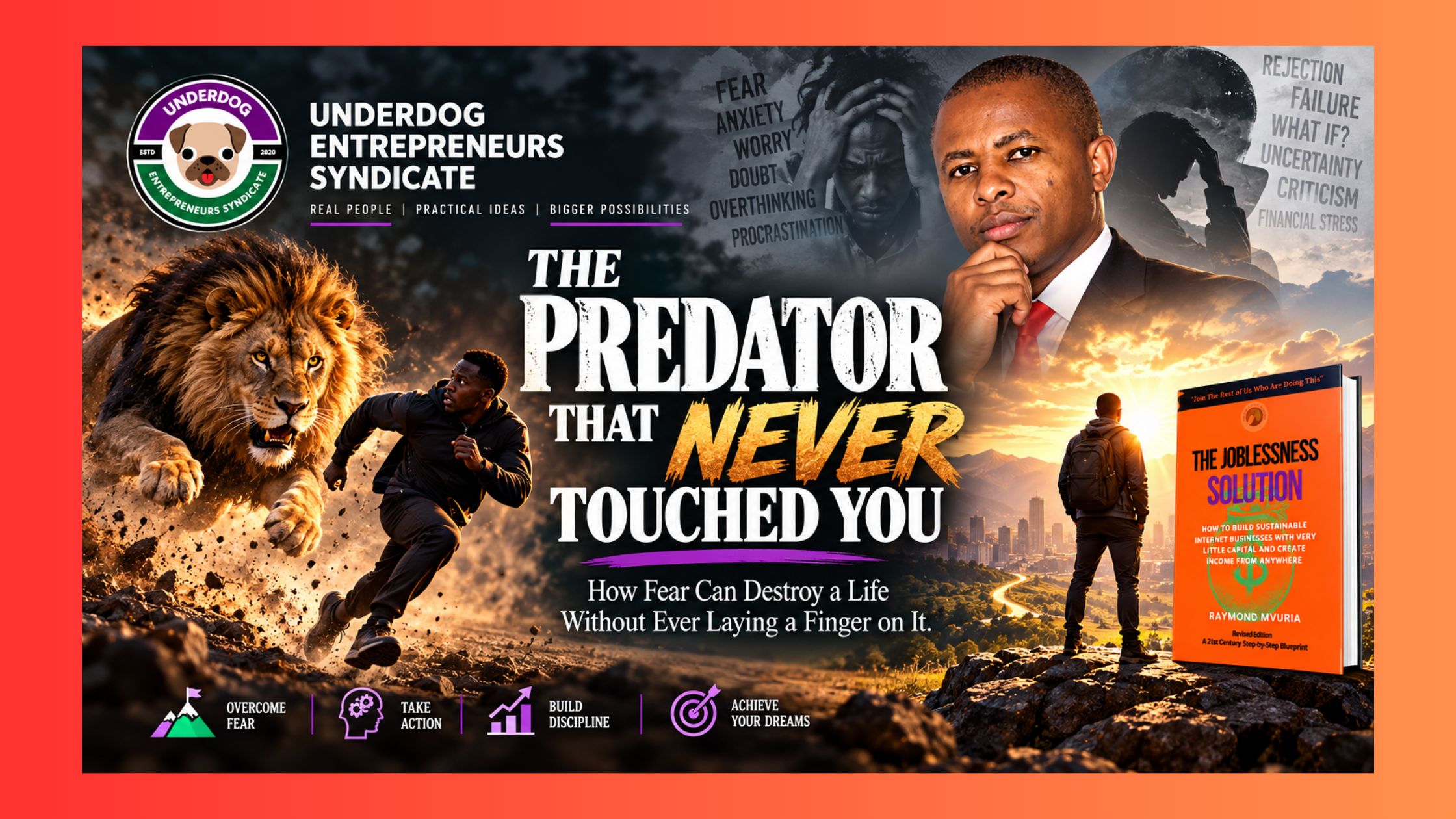
How Fear Can Destroy a Life Without Ever Laying a Finger on It
In the wild, an animal does not always have to be caught by a predator to die.
Sometimes, the chase itself is enough.
Wildlife biologists have documented a condition known as capture myopathy, in which extreme stress and physical exertion can trigger severe muscle damage, metabolic disturbances, kidney failure, and even death. The animal may escape the predator, only to succumb to the physiological consequences of the ordeal.
Think about that for a moment.
The predator never caught it. Yet the encounter may still cost it its life.
And somewhere in the human world, a similar tragedy is unfolding every day.
Not in the forests.
Not on the savannah.
But inside the minds of people who are afraid to begin.
People who have dreams they talk about passionately but actions they keep postponing.
People who have business ideas but are terrified of losing money.
People who want to leave destructive situations but are frightened of what comes next.
People who have gifts, talents, and extraordinary potential, yet spend years waiting for the perfect moment to use them.
Their predators have different names.
Failure. Rejection. Poverty. Criticism. Embarrassment. Uncertainty. What if it doesn’t work? What if I lose everything? What will people say?
And unlike the predator in the wild, these ones do not always have to chase you.
Sometimes, they only have to live in your imagination.
THE FIRST TRAGEDY: YOUR BODY STARTS FIGHTING A BATTLE THAT HASN’T HAPPENED
When a human being perceives a threat, the brain activates stress responses that prepare the body to fight, flee, or respond in other ways.
The heart rate increases. Muscles tense. Attention narrows. Stress hormones help mobilize energy.
This response can save your life when danger is real and immediate.
But what happens when the threat is not a charging lion?
What happens when it is the fear of starting a business, the anxiety of making a sales call, the possibility of being laughed at, or the uncertainty of investing in yourself?
Your body can still respond to perceived danger.
You rehearse a presentation for weeks but never deliver it.
You want to approach a potential client, but you imagine the rejection before you even make the call.
You have a brilliant idea, but instead of testing it, you spend months imagining every possible way it could fail.
The danger may be hypothetical, but the distress you experience can be very real.
When stress becomes prolonged, it can contribute to sleep disturbances, headaches, digestive problems, anxiety, and other health difficulties. It can also interfere with concentration, judgment, and decision-making.
And so the person who is trying to protect themselves from the pain of failure may end up suffering from the burden of never trying.
You can spend so much energy preparing for a disaster that never comes that you have none left to build the future you actually want.
THE SECOND TRAGEDY: YOU ESCAPE THE PREDATOR, BUT YOU LOSE YOUR DESTINATION
Imagine a young man who wants to build a digital business.
He has a laptop. He has internet access. He has learned valuable skills. He has even identified a problem people are willing to pay him to solve.
All he needs to do is begin.
But then the questions arrive.
What if nobody buys?
What if my friends laugh at me?
What if I invest my savings and lose them?
What if someone else is already doing this better?
What if I fail publicly?
He decides to do more research.
He watches another tutorial.
He downloads another guide.
He redesigns his logo.
He changes his business name.
He tells himself he will launch when he feels more confident.
One week becomes one month.
One month becomes one year.
Meanwhile, someone with fewer skills, fewer resources, and perhaps a less impressive idea begins offering the same service.
That person makes mistakes. Learns from customers. Improves the offer. Makes the first sale. Builds experience.
Our young man is still preparing.
The competitor was not necessarily more talented.
He was simply willing to face uncertainty while the other man was waiting for certainty.
And here lies one of the cruellest consequences of fear:
Fear does not always destroy your dream by making you fail. Sometimes, it destroys your dream by preventing you from giving it a chance to succeed.
The business that never launched cannot generate revenue.
The book that was never published cannot reach readers.
The application that was never submitted cannot win the opportunity.
The conversation that was never started cannot open the door.
There is no dramatic collapse. No public announcement of defeat. No single moment when everyone can point and say, “That is when the dream died.”
It happens quietly.
Through postponed decisions.
Through opportunities surrendered to hesitation.
Through another day of telling yourself, “Soon.”
THE THIRD TRAGEDY: WORRY MAKES YOU SUFFER TWICE
There is a difference between a problem and the suffering we create by repeatedly imagining that problem.
Suppose you are facing a financial challenge.
The problem is real. The bills are due. The money is insufficient.
Concern can help you examine your situation, negotiate with creditors, seek additional income, or develop a repayment plan.
But worry can take you somewhere else.
You lie awake imagining eviction.
You picture your family’s disappointment.
You imagine losing everything you have worked for.
You replay conversations that have not happened.
You create ten frightening futures before breakfast, yet take no concrete step toward changing the present.
The actual problem remains, but now you are also carrying the emotional weight of every disaster you have imagined.
This is not to say that financial hardship is imaginary or that positive thinking can eliminate it. Real problems require real solutions, and some circumstances are beyond an individual’s immediate control.
But there is a critical distinction between acknowledging danger and mentally living inside that danger all day.
Planning asks, “What can I do about this?” Worry keeps asking, “What if everything goes wrong?”
One directs your attention toward a response.
The other can trap you in an endless rehearsal of helplessness.
And when that pattern persists, your health, relationships, sleep, and ability to make sound decisions may suffer.
The problem is difficult enough.
You do not have to let the anticipation of the problem consume the strength you need to address it.
THE FOURTH TRAGEDY: YOU CAN BE ALIVE AND STILL WATCH YOUR DREAMS DIE
Not every death is physical.
Some deaths occur in the space between what a person could have become and what they eventually allowed themselves to attempt.
A writer dies a little when fear keeps the manuscript in a drawer for twenty years.
An entrepreneur dies a little when the fear of rejection prevents them from offering their services to a single customer.
A talented young person dies a little inside when repeated criticism convinces them that their abilities are worthless.
A person with a powerful message remains unheard because they are terrified of being misunderstood.
These are not literal deaths, and they are not irreversible destinies. People can reclaim abandoned ambitions, begin again, and build meaningful lives at many stages.
But the loss can still be profound.
Years pass. Circumstances change. Opportunities disappear. Responsibilities accumulate.
And one day, a person looks back and realizes that the thing they feared most was not failure.
It was the possibility of discovering what they were capable of.
Because failure, painful as it may be, can teach you something.
But a dream that is never attempted leaves you with a different question:
What might have happened if I had tried?
That question can follow a person for decades.
THE FIFTH TRAGEDY: THE PREDATOR BECOMES PART OF YOUR IDENTITY
Perhaps the most dangerous thing about prolonged fear is that you can eventually stop recognizing it as fear.
You begin calling it prudence.
You call it being realistic.
You call it waiting for the right time.
You say you are protecting your peace.
You say you are not ready.
Sometimes, these statements are entirely reasonable. Preparation matters. Caution protects you from genuine risks. Rest is necessary. Not every opportunity deserves pursuit.
But sometimes, beneath all these respectable explanations, there is a simpler truth:
You are afraid.
And rather than acknowledge the fear and decide how to respond to it, you have built your life around avoiding it.
You avoid the people who might reject you.
You avoid the opportunities that might expose your weaknesses.
You avoid the decisions that might reveal whether your idea can work.
Eventually, your world becomes smaller.
Not necessarily because your abilities have diminished, but because your willingness to encounter discomfort has.
The predator no longer needs to chase you.
It has taught you to avoid the places where your life could expand.
And the saddest prison is the one in which the prisoner mistakes the walls for safety.
SO, HOW DO YOU ESCAPE?
The answer is not to eliminate every fear.
That is neither realistic nor necessary.
The answer is to learn how to act wisely even when fear is present.
Start by distinguishing real danger from anticipated discomfort.
If a decision involves serious financial, legal, or physical risk, examine it carefully. Gather evidence. Seek qualified advice when necessary. Develop a plan that limits the downside.
But if the main threat is embarrassment, rejection, criticism, or the possibility of making an imperfect beginning, consider whether avoidance is costing you more than action would.
Then reduce the size of the action.
Do not demand that you build an entire business today. Contact one potential customer.
Do not demand that you write an entire book this week. Write one page.
Do not demand that you become completely confident before speaking. Have one honest conversation.
Do not wait until every doubt disappears. Take a small, considered step that produces real information.
Confidence often grows through experience, not through endless mental preparation.
And when worry becomes overwhelming, persistent, or disruptive to your daily life, seeking support from a qualified mental health professional is a practical form of strength, not a sign of weakness.
You were not designed to spend your entire life in a state of emergency.
Learn to rest.
Learn to assess risks.
Learn to ask for help.
Learn to act.
THE FINAL LESSON
Return to the animal in the wild.
The stress response that once helped an animal survive danger can, under extreme circumstances, contribute to its physical collapse.
Human beings face a different and more complicated struggle. Our fears can concern events that have not happened, outcomes we cannot predict, and judgments we imagine others might make.
Yet the lesson is worth considering.
A threat does not have to touch you to affect you.
A possibility does not have to become reality to occupy your mind.
A rejection does not have to occur for you to avoid the opportunity.
And failure does not have to happen for fear to make you surrender.
That is why you must learn to recognize the difference between a warning that deserves your attention and an imagined catastrophe that keeps you motionless.
You cannot control every circumstance.
You cannot guarantee success.
You cannot eliminate uncertainty from the human experience.
But you can learn not to surrender every decision to the possibility of pain.
Because somewhere inside you is an idea that needs testing, a conversation that needs starting, a skill that needs developing, a book that needs writing, or a life that needs rebuilding.
It may not work exactly as you imagine.
You may stumble.
You may have to change direction.
You may discover that the original dream needs a better plan.
That is part of being human.
But you will at least have given reality a chance to answer the questions that fear has been asking on your behalf.
Do not let the fear of losing become the reason you never build.
Do not let the fear of rejection become the reason you never reach out.
Do not let the fear of failure become the reason your greatest work remains unfinished.
And above all, do not spend your life running from a future that exists only in your imagination while the real opportunities of the present pass you by.
The predator may never touch you.
But you must decide whether you will allow its shadow to determine how you live.
Your dream does not need you to become fearless.
It needs you to stop making fear the final authority over your actions.